

Cummins to Supply Battery Storage for Major U.S. Data Center Project
Cummins Inc. (NYSE: CMI) has announced that its Power Generation business has been selected to supply battery energy storage systems (BESS) for a major data center project in the United States. The deployment is expected to become the largest BESS project completed by Cummins to date and represents an important expansion of the company’s role in providing power infrastructure for the rapidly growing data center industry.
The battery storage systems will support utility-defined requirements associated with the project, including managing fluctuations in electricity demand generated by artificial intelligence (AI) workloads, reducing load oscillations and improving ride-through performance. As data centers increasingly incorporate power-intensive AI computing, operators and utilities are seeking technologies that can respond quickly to changes in electricity consumption while maintaining grid stability and power reliability.
For Cummins, the project demonstrates the growing importance of energy storage within modern data center power architectures. It also highlights the company’s ability to combine conventional power generation technologies with newer energy solutions to address the increasingly complex electricity requirements of large-scale computing facilities.
“This project is an important achievement for Cummins and reflects the confidence customers place in our ability to deliver innovative energy solutions at scale,” said Jenny Bush, president of Cummins’ Power Systems business. She noted that continued growth in data center capacity is creating demand for a broad range of reliable power technologies.
Cummins provides solutions spanning diesel standby generation, natural gas prime power, battery energy storage and integrated microgrid systems. According to Bush, the latest project reinforces the company’s commitment to helping data center customers develop power infrastructure that is reliable, resilient and increasingly sustainable.
Battery Storage Addresses AI Power Demand
The BESS installation will provide an additional layer of flexibility within the data center’s overall power system. AI-focused data centers can experience rapid and significant changes in electricity consumption as computing workloads shift. These fluctuations can create challenges for utilities and may require additional power-management capabilities at the point where the facility connects to the grid.
Cummins’ BESS solution is designed to respond rapidly by charging or discharging electricity as required. This capability can help reduce sudden demand spikes, smooth fluctuations in the facility’s electricity profile and improve power quality. By helping stabilize the load seen at the utility interconnection point, the system can support compliance with utility-defined operating requirements.
Energy storage can also provide a fast-response resource during disturbances. The ability of batteries to deliver power quickly can help improve ride-through capabilities and provide additional resilience while other generation assets respond or while grid conditions are restored.
The growing adoption of AI is making these capabilities increasingly relevant to data center developers. AI training and inference workloads require substantial computing resources, which in turn can translate into higher and more dynamic electricity demand. As hyperscale facilities become larger and more power-intensive, operators are evaluating BESS as part of a broader strategy for managing electrical infrastructure.
BESS Becomes a Strategic Data Center Tool
Cummins launched its BESS solutions in May 2025 as part of its efforts to expand its power technology portfolio and respond to changing customer requirements. The company’s latest project demonstrates how battery storage is moving beyond conventional energy-shifting applications and becoming an important component of data center power strategies.
Data center developers are facing several challenges as demand for computing capacity increases. Grid interconnection processes can take years in some markets, available transmission capacity can be limited and electricity costs can fluctuate. At the same time, developers are under pressure to bring new computing facilities online quickly.
BESS can help address some of these challenges by providing flexible power capacity and supporting more efficient use of available grid resources. Depending on the project design, batteries can be deployed as a bridge-to-grid solution, paired with onsite generation or incorporated into a larger microgrid.
For facilities waiting for permanent grid connections, battery storage can potentially support interim power strategies. Once grid service is established, the same storage equipment can continue to provide value through peak demand management, load smoothing, resilience and other grid-support functions.
Cummins has designed its BESS offering to accommodate a range of configurations. The company says its systems can be integrated with diesel and natural gas generators and incorporated into broader energy management and microgrid architectures. This flexibility allows customers to combine multiple power resources rather than relying on a single technology.
Technology Designed for Hyperscale Facilities
The Cummins BESS platform for data center and AI campus applications incorporates several features intended to support large-scale, high-reliability power environments.
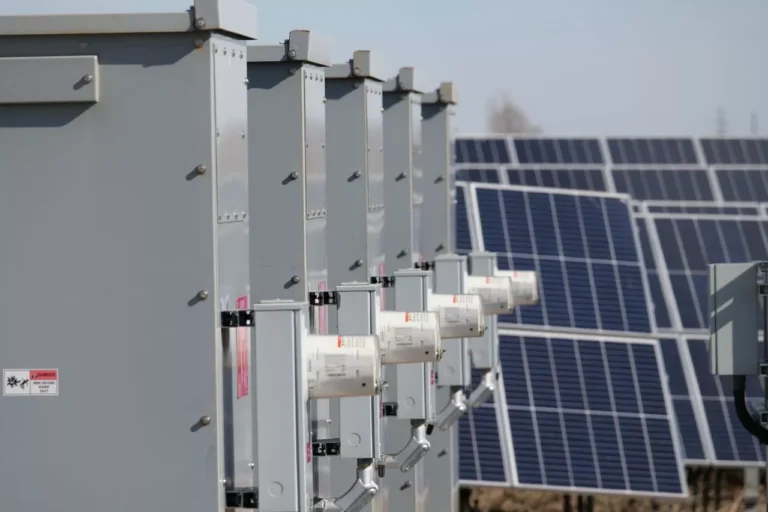
The system uses a 5 MWh nominal battery capacity and lithium iron phosphate (LFP) battery chemistry. LFP technology is widely used in stationary energy storage because of its combination of energy density, cycle performance and thermal stability.
The BESS also incorporates liquid cooling thermal management. Effective thermal management is important for large battery installations because maintaining appropriate operating temperatures can help support system performance, reliability and battery life.
Cummins has also designed the system around a flexible DC block architecture that can work with multiple power conversion system (PCS) and energy management system (EMS) ecosystems. This approach provides customers with greater flexibility when integrating battery storage into existing or planned electrical infrastructure.
The BESS solution is described as bridge-to-grid ready and can be integrated with diesel and natural gas generator systems. Such integration can allow data center operators to coordinate multiple generation and storage resources according to facility demand and grid conditions.
The system is designed to meet a range of industry and safety standards, including UL 9540A, UL 9540, UL 1973, NFPA 855, NFPA 68, IEEE 1547 and UL 1741 SA/SB.
Supporting the Next Generation of Data Centers
The planned deployment represents more than an expansion of Cummins’ battery storage business. It reflects a broader shift in how data center developers are approaching power infrastructure as AI and cloud computing drive unprecedented electricity demand.
Traditional standby generators remain an important part of data center reliability strategies, but battery storage can provide capabilities that complement generation equipment. Batteries can respond almost instantaneously to changes in demand, while generators can provide longer-duration backup power. Combining the technologies can create a more flexible and resilient power architecture.
Cummins’ experience in power generation gives the company an established platform from which to expand its energy storage offering. With more than a century of experience in power systems, the company is positioning BESS as another component of an integrated portfolio designed to address the evolving needs of large electricity consumers.
“The future of data center growth depends on finding smarter, faster ways to deploy and manage power. BESS is quickly becoming a critical part of the modern data center power strategy,” Bush said. She added that battery storage can support bridge-to-grid applications, peak demand management and long-term resilience.
As AI adoption continues to increase electricity requirements across the data center sector, technologies capable of managing rapid changes in power consumption are expected to become increasingly important. Cummins’ largest BESS deployment to date signals the company’s growing focus on this market and its broader strategy of combining generation, storage and microgrid technologies to help customers build scalable and resilient power infrastructure.
Source Link: https://www.businesswire.com/