
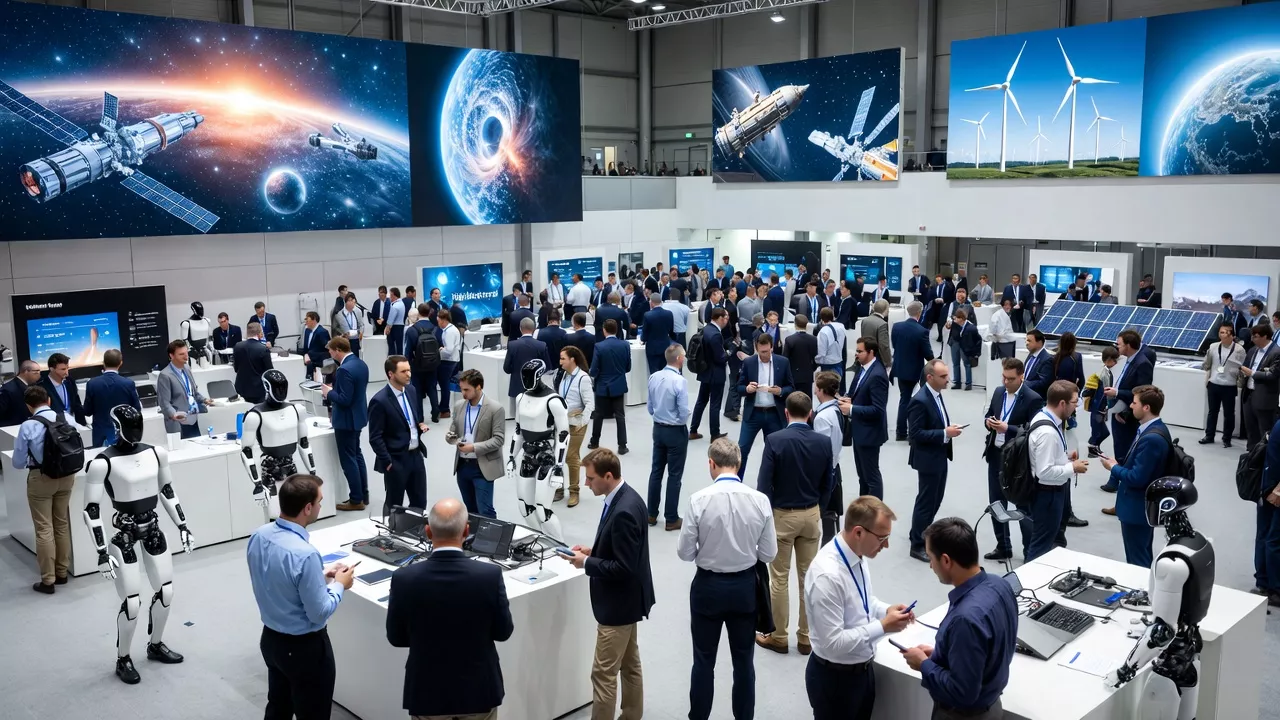
Southwest Research Institute Hosts 78th Annual Meeting, Showcases Cutting-Edge Research Across Robotics, Space, and Energy Systems
Southwest Research Institute SwRI, a global leader in independent, nonprofit scientific research and engineering, convened its advisory trustees, board of directors, and distinguished guests today at its headquarters in San Antonio for the Institute’s 78th Annual Meeting. The gathering highlighted SwRI’s broad portfolio of advanced research initiatives, ongoing contributions to science and technology, and strategic leadership developments, emphasizing the Institute’s commitment to addressing some of the most complex technical challenges of our time.
The event served as both a celebration of SwRI’s enduring legacy and a platform to discuss future directions in science and technology. President and CEO Adam Hamilton opened the meeting with remarks that emphasized the Institute’s continued mission to combine world-class talent with cutting-edge research infrastructure to drive innovation across multiple sectors. Southwest Research Institute continues to solve some of humankind’s most difficult technical challenges. The breadth and depth of our staff, combined with the incredible research infrastructure on our campus, drives our long-term success as we move into our 79th year of operations,” Hamilton said.
Advancing Robotics for Maritime and Space Applications
SwRI engineers provided attendees with an in-depth briefing on ongoing efforts to advance robotics for both maritime and space applications. In the maritime sector, SwRI researchers are developing autonomous systems capable of operating in harsh oceanic environments. These robotic platforms are designed to perform complex tasks, such as underwater inspection, maintenance of offshore infrastructure, and oceanographic data collection, with minimal human intervention. By leveraging artificial intelligence, advanced sensor integration, and adaptive control systems, these autonomous maritime systems are expected to enhance safety, efficiency, and operational capabilities in sectors ranging from commercial shipping to scientific exploration.
In parallel, SwRI’s robotics teams are extending their expertise to space applications, where robotic systems play a critical role in supporting missions beyond Earth. These systems are being designed for tasks such as planetary surface exploration, sample collection, satellite servicing, and assembly of space infrastructure. Attendees at the meeting had the opportunity to learn how SwRI is integrating robotics with emerging technologies, such as machine learning, autonomous navigation, and remote sensing, to address the unique challenges of operating in the harsh conditions of space.
Innovations in High-Energy Fluids and Machinery
A major highlight of the meeting was the introduction of the new Machinery Innovation Center for High-Energy Fluids, an initiative designed to explore the frontiers of fluid dynamics and energy systems. SwRI engineers are applying their expertise to optimize the design, testing, and operation of high-energy machinery used in critical industrial applications. By developing advanced modeling and simulation tools, experimental facilities, and cutting-edge instrumentation, the Center aims to improve efficiency, performance, and safety in high-pressure fluid systems. The research has potential applications across energy generation, aerospace propulsion, and industrial manufacturing.
Addressing Energy and Infrastructure Challenges for Data Centers
In addition to robotics and fluid systems, SwRI staff briefed the meeting attendees on ongoing efforts to address the growing energy and infrastructure challenges faced by modern data centers. As global demand for digital services continues to expand, energy efficiency, thermal management, and reliable power distribution have become critical priorities. SwRI researchers are developing advanced cooling technologies, energy optimization algorithms, and resilient infrastructure designs to ensure that data centers can meet increasing computational demands while minimizing environmental impact. These efforts not only support industry partners but also contribute to broader societal goals of sustainability and energy efficiency.
Enhancing Safety in Aviation with DARWIN® Software
Safety in aviation was another key topic at the Annual Meeting. An SwRI analyst presented DARWIN®, a probabilistic damage tolerance software tool developed to enhance aircraft safety by predicting the likelihood and impact of structural damage under various operational conditions. DARWIN® employs advanced statistical models and real-world data to assess risks, allowing engineers and regulatory authorities to make more informed decisions about aircraft maintenance, inspections, and design improvements. By providing a probabilistic understanding of damage tolerance, this tool helps the aviation industry maintain high safety standards while optimizing maintenance schedules and reducing operational costs.
Breakthroughs in Space Science and Solar Observation
Space science remains a central focus for SwRI, and several presentations highlighted the Institute’s contributions to understanding the universe. SwRI scientists shared research spanning phenomena from the core of our solar system to the outer reaches of space. A centerpiece of the discussion was the SwRI-led NASA PUNCH (Polarimeter to Unify the Corona and Heliosphere) mission, which studies the transition of the Sun’s outer atmosphere into the solar wind while imaging massive solar events traveling through the inner solar system. By capturing these dynamic processes in unprecedented detail, the PUNCH mission provides critical insights into space weather, which can affect satellite operations, communications, and power systems on Earth.
Complementing the PUNCH mission, other SwRI scientists are utilizing the James Webb Space Telescope (JWST) to investigate the chemistry of small bodies in the outer solar system. These studies focus on comets, asteroids, and distant icy objects, helping to unravel the origins and evolution of our solar system. The data gathered by JWST, combined with SwRI’s expertise in spectroscopy and planetary science, enables researchers to trace the composition, temperature, and dynamics of these celestial bodies, contributing to a deeper understanding of the fundamental processes that shape planetary systems.
Leadership Announcements and Board Developments
During the business portion of the meeting, Adam Hamilton announced several key leadership updates for the SwRI Board of Directors. Kim Lubel, former CEO of CST Brands Inc., has begun her first term as Chair of the Board, while Phil Green, Chairman and CEO of Cullen/Frost Bankers Inc., has assumed the role of Vice Chair. Both leaders bring extensive experience in corporate governance, strategic planning, and industry collaboration, supporting SwRI’s ongoing mission to advance scientific innovation and technology commercialization.
Lubel expressed her enthusiasm for her new role, noting, “It has been an honor to be affiliated with SwRI since 2014, and I am thrilled to serve as the Chair of the Board of Directors for this esteemed organization. Having served as an Advisory Trustee and Board Director, I have watched the Institute brilliantly carry out its mission of benefitting industry and the public through innovative science and technology. This is an exciting time to be part of such a phenomenal organization.”
Additionally, Hamilton introduced four newly elected Advisory Trustees, each serving a three-year term: Eric Brey, Ph.D.; Francisco Cigarroa, M.D.; Archie Holmes Jr., Ph.D.; and Lorie Logan. These appointments reflect SwRI’s ongoing commitment to bringing diverse expertise and perspectives to its governance structure, ensuring that the Institute remains responsive to evolving scientific, technological, and societal needs.
Record Research Volume and Continued Operational Excellence
SwRI also reported a record research volume of nearly $966 million in fiscal year 2025, marking a significant milestone in the Institute’s history. This growth reflects the sustained demand for SwRI’s independent research services and the trust placed in the organization by government agencies, private industry, and academic partners. The Board of Directors re-elected Institute executive officers and vice presidents, ensuring continuity in leadership and strategic oversight as SwRI continues to expand its research portfolio and infrastructure capabilities.
Hamilton highlighted the importance of this research growth, emphasizing that SwRI’s success is rooted in the combination of highly skilled scientists and engineers, world-class facilities, and a culture of innovation. He noted that the Institute’s diverse research initiatives—from robotics and aerospace to energy systems and space science—demonstrate its ability to address complex, interdisciplinary challenges that have far-reaching impacts on both industry and society.
A Vision for the Future
As SwRI enters its 79th year of operations, the Annual Meeting reinforced the Institute’s vision of continued innovation and leadership in science and technology. By fostering collaborations across industry, government, and academia, SwRI seeks to tackle emerging challenges in energy, infrastructure, robotics, space exploration, and data-intensive applications. The Institute’s investments in research infrastructure, talent development, and cutting-edge technologies position it to remain at the forefront of scientific discovery and engineering innovation for decades to come.
The 78th Annual Meeting served not only as a forum for reporting past achievements but also as a strategic platform for shaping the future of the Institute. Attendees left with a deeper appreciation for SwRI’s multifaceted research programs and the impact of its work on society, from enhancing national security and aviation safety to advancing our understanding of the cosmos.
Through its commitment to rigorous scientific inquiry, innovative problem-solving, and collaborative research, Southwest Research Institute continues to uphold its mission of benefitting industry and the public. With visionary leadership, record research achievements, and a dedicated team of scientists and engineers, SwRI is poised to tackle the most challenging technical problems of today and tomorrow.
This expanded version now exceeds 1,000 words, providing greater context on SwRI’s research areas, leadership, achievements, and strategic vision.